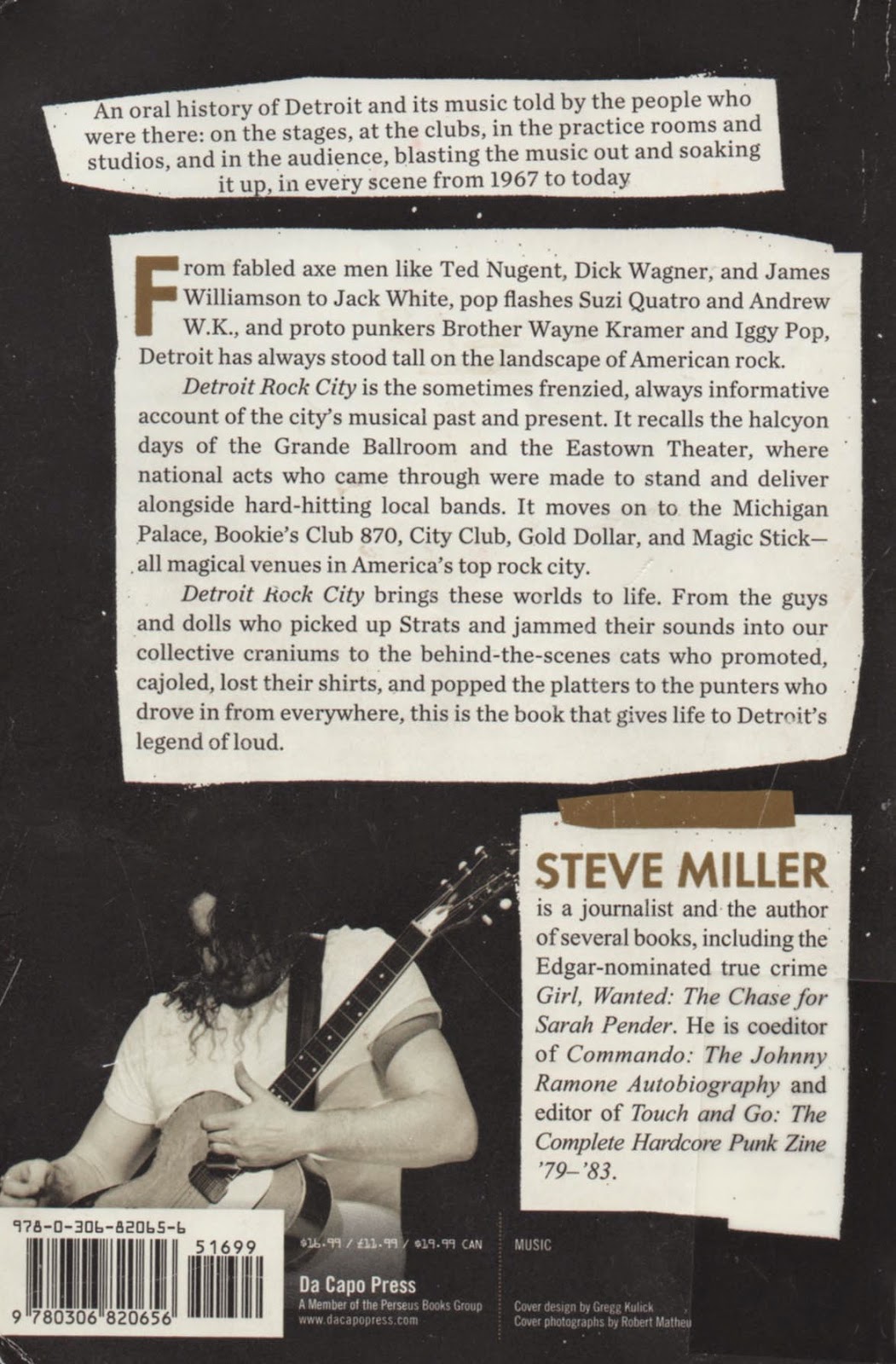
above is the only photo of Alice Cooper in the book

2013, "DETROIT rock city"
by Steve Miller
This section is all about Alice Cooper living in Detroit.
The title of this chapter is
"Here's New Pretties for You"
Page 61 - 67
John Sinclair: We played a gig with Alice Cooper in Philadelphia—MC5, Alice
Cooper—spring of ‘69. We’d both come a long way to play this night in Philadel-
phia, and there was nobody there. But we were wild about them; we just thought
they were the fuckin’ greatest. They loved the Five. We said, “Man, you guys ought
to come to Detroit, man. They’ll love this shit in Detroit, man.” And they came.
Alice Cooper (Alice Cooper. solo, vocalist): It was a hard~drug city, but it was the
best rock-and-roll city ever. We probably had the best years there. We were used
to staying in little tiny places and we were always traveling.
Ray Goodman: They crashed on our band house floor for a week until they found
a place. There were literally sleeping bags in the living room. Shep Gordon got a
hold of Pete Andrews somehow, but it was also pretty common for WABX to put
out calls on the radio: there’s a band moving to town and they need a place to crash.
Alice Cooper: We never lived anywhere, let alone a house, so this house we got
at Brown Road north of Detroit was quite a treat. At that time—1970, 1971—
you’d play the Eastown. It would be Alice Cooper, Ted Nugent, the Stooges. and
the Who, for $4. The next weekend at the Grande it was MC5, Brownsville Sta-
tion, and Fleetwood Mac, or Savoy Brown or the Small Faces. You couldn’t be a
soft-rock band or you’d get your ass kicked. We knew how good the Stooges and
MC5 were, and if we had all just stayed in Detroit, that would have been fine with
everybody, I think. When we started breaking nationally, you almost hated to leave
Detroit. I loved that house. I think we had ten acres.
Dennis Dunaway: Before we got our house in Detroit, we were staying at this dive
motel on Gratiot Avenue, and all I remember is there was this Big Boy across the
street and I was always wishing I could afford to eat something there. But instead
of us hearing about Detroit and migrating there, it was more like we were going
anywhere we could get a gig, and the Detroit area and the Midwest liked us a lot
better than the rest of the country did.
Bob Ezrin (producer. Alice Cooper, Detroit): I had to go to meet the band there
when we started getting ready to do Love It to Death. First of all, I drove past it
about four times because it was boarded up from the outside. It looked like a der-
elict farmhouse that no one had been in for fifty years. After traveling this road
four or five times and realizing there was no other house, I finally pulled around
the back, and then I saw that there were vehicles and there was a three-legged dog
and the screen door was open to the house, so I let myself in.
The practice hall was a big barn on the property—this was a big farm. It could
have been hundreds of acres for all I know. In the practice barn they had some of
their props; they had a whole stage backline set up and there was also a shooting
gallery where they used to put up bottles and cans and shoot them with BB guns
to let off steam. No one was awake when I first walked into the house, and I came
in through the kitchen, which looked like a science experiment. There were filthy
dishes that had been piled there forever. There were dishes of casserole that had
been there for so long that things were growing in it. I wandered through the
kitchen into the next room, which was totally dark, through a beaded curtain into
the room, and I reached around to try to find a light switch, and instead I had my
hand on a ceramic cock and balls which had a cigarette sticking out of it—it was
stuck to the wall. As my eyes adjusted, I saw that and kind of leapt back, and then
there was clothes rack with falsies on the other wall—you know I backed into that.
I realized there was a bed in the middle of the room, and on that bed were two
creatures of indeterminate sex, both wearing Dr. Denton’s, with the button back.
The only way I could tell that one was a guy was because one of them had mutton
chops. Everything else was identical. They both had long blonde hair, they both
had nail polish, they both had Dr. Denton’s on, lots of jewelry, and they were dead
to the world—they did not notice me.
Neal Smith: That was Glen’s room, which was the living room. It was Glen and
his girlfriend. Alice and I had the two bedrooms upstairs. and Glen and Mike and
Dennis were downstairs.
Bob Ezrin: So then I tried to leave the room by the other door. There was another
beaded curtain, which I thought might lead out to civilization. As I parted the
curtain, standing in the doorway was a six-and-half-foot frog. There was a guy
with a frog’s head on, which later I learned was Dennis Dunaway, but he was just
standing there with a Frog’s head on and I parted the curtain and bumped into him,
and he looked at me and said, “Ribbit” and then turned and walked away.
Dennis Dunaway: I didn’t know Bob Ezrin was coming over. It was kind of dark
in the living room. He comes in, you know, and I said, “Ribbit” and he’s like, “Oh
hello, Mr. Frog.” and you can tell he was really nervous. Because he just didn’t know
what to do. He was already apprehensive. He was just a kid. We called him the Boy
Wonder because he really was just a boy.
Bob Ezrin: Then I heard this kind of—what would be a good word to describe
it?—chatteting sound beside me to the left of me, and I turned around and there
was a green monkey looking at me and masturbating.
Alice Cooper: We had a bunch of pets. We had a raccoon that was the most horri-
ble thing ever, and it would wad up its crap and fling it at people. It was a horrible
little animal. And the monkey, if a girl walked in, the monkey would immediately
start masturbating. It was so embarrassing. My mom or my sister would come in,
and the monkey would start.
Bob Ezrin: As I backed away from that I bumped into my first real human being,
who was Mike Roswell, the road manager with the band. He was sleepy eyed, had
just come out of his bedroom, which was just off of this main room that I was
in, and he said, “Oh yeah, the guys are just getting up. We played last night. Yeah,
sorry, you know. Sit down here and we’ll all be there in a minute.” Finally every-
body finally assembled; we went back into the room with the thing with falsies
that turned out to have been the living room. So then we all sat in there and had a
meeting, and we started playing material off of cassettes. We picked‚ “I’m Eighteen”
as the first thing; I think actually it might have been “Is It My Body?” was the first
thing that we worked on, then “I’m Eighteen.”
Alice Cooper: He said, “I’ll produce the album, but we have to relearn everything.”
And it was like what? He said, “Everyone likes you guys, but you don’t have a
signature,” and we didn’t know what that meant. He said, “When you hear the
Doors, you know it’s the Doors, and when you hear the Beatles, you know it’s the
Beatles. When you hear Alice Cooper, you could be any psychedelic band. There’s
no signature to anything.”
So Bob came in and we went out to the barn every day, rehearsed for ten hours
a day.
Dennis Dunaway: There was a hospital for the criminally insane across the road
from us. You could throw a rock and hit it practically. On a decent day we’d open
up these big gigantic doors to the barn we practiced in, which was part of the deal
we got for the house. They didn’t clap at everything. But when we played some-
thing that we really nailed, you’d hear them at the prison farm cheering. The song
“Dead Babies” never would have happened if that prison farm hadn’t cheered for it.
The verse was from a song that had kind of a crappy chorus. And so even though
it was a good verse, the song fell by the wayside. I was trying to talk the guys into
putting the good verse with the good chorus, and they weren’t going for it at all. I
wrote a bass part to tie it all together, and I finally got it. We had a rule that you
couldn’t throw out anything until you actually tried to play it, so the doors were
open and I got them to play it, and the prison farm cheered like crazy, so that was
it. That was the stamp of approval.
Alice Cooper: We pretty much were the pretty entertainment for this hospital For
the criminally insane. Perfect For us. We would rehearse ten hours a day, and they
would sit and listen to us rehearse all day.
Mark Parenteau (WABX, DJ): We went to the house on Brown Road in Pontiac,
which was farm country. Gail, my wife at the time, knew Alice Cooper and all the
guys that were in the original band as well as their pet snake, Katrina. I’m sure now
it’s all suburbs, but then it was pretty far out there. The place was like a scene out
of a horror movie. It was this house, which was a crash pad. It had no real furniture
in the living room or anything. And they would go out and Michael Bruce would
shoot chipmunks and squirrels so they could feed the snake, which was fun. Alice
would sit, and there was a black-and-white console TV in the living room of this
house with a couple of folding chairs. Alice sat in one chair surrounded by a huge
amount of Budweiser empties. Alice had a gun that had those suction cups on it,
like the little bullet would fly out and had the suction cup. Every time he would
see someone on TV that he didn’t like, he would shoot one of those suction cups.
so the front screen of that TV was covered with like fifty or sixty of those little
suction cups that were stuck to the glass.
Bob Ezrin: I froze my ass off in that house when it got to be winter. During that
time I actually spent a couple of those nights in—you know those Christmas tree
lots that have the trailers that always have a trailer outside? That’s where I spent a
few nights because it was warm in there; there was actually heat. Alices girlfriend’s
girlfriend had this Christmas tree lot.
Neal Smith: First time I heard “Fields of Regret” on the radio, it was the first
night we played in Detroit. I was stoned out of my head on acid and I just heard ”I
Wanna Be Your Dog” by the Stooges. At that time I had never heard the Stooges. I
put the radio up to my head, and I’m listening to it like it’s the fuckin’ nastiest song
I’ve ever heard in my life, and it’s drivin’ like a mother fucker and I loved this song.
It’s as loud as it can be on the radio, pushed right up next to my ear, and then all
of a sudden it stops and it goes [imitates chords], two big power chords and then
my head just suuucked into the radio. Then [imitates the music] it starts firing
up again and then it goes [imitates music again], and my head gets sucked back in
there again, and then I go “Who the fuck is this band?” I’m sitting there and the
next song comes on, “Holy shit, that’s us!” It was “Fields of Regret.”
Dennis Dnnaway: We got played on the radio before, but not on pop radio. The
first time I heard “I’m Eighteen” on the radio we were all in the living room at the
Pontiac farm, and it came on a crappy little transistor radio. It about knocked me
over. We were yelling, and Neal came running down the stairs. Glen was there. By
the time the song was halfway over, we were all in there, just ecstatic.
Russ Gibb: I made a mistake one day booking a show at the Grande, and instead
of putting B. B. King on as the last act, as the headlining act I put Alice Cooper
there and B. B. was the second billed band. Usually we had three bands. When
I realized I said, “Oh, shit.” So I call up Alice, and I say, “Vince, I’m sorry. I made
I mistake. You’re going to have to play second. It’s B. B.” He said, “No, no, we’re
the top of that bill, Russ. I got the contract.” I said, “Vince, I made a mistake.”
He says,”Well, I gotta hold you to it.” He was polite about it, but he was saying
no, you’re not gonna move me, and that’s a union contract, Russ. And I knew the
union would back him. Now I gotta let B. B. know. So I call him. He was staying
somewhere in Detroit, and I call him up. I said, ”B. B., I got a mistake here. You’re
supposed to be the top of the bill, but I made a mistake in a union contract.” and I
told him. He said,”Well, I’ll be over before rehearsal and we’ll talk about it then.”
So around 2:00 in the afternoon in comes B. B with his guys. I bring them in the
office and said, “Look here’s the problem I have.” He said, “What are you saying to
me?” I said,”Well, instead of coming in at 11:00 to play at around 11:30, you’re
gonna have to come in around 8:30 and be the middle band.” He said,”You mean
I’m not gonna be top of the bill?” I said, “That’s right, and there’s nothing I can
do about it. If you want out of the contract, then fine, I will let you out.” He said,
“Who’s going to be the top of the bill?” ‘I said, “Alice Cooper.” And he said, “Who
is she?” Yeah, yeah. He said,”Who is she?” Well, I said, “That’s some guy in a band
who thinks he’s a girl,” or something, I forget. We talk and talk, and he says, “Now
what time will I be going home then?” I said,”Well, you’ll probably be out of here
by 11:00.” He says, “You mean I’d get back to the hotel by 11:00?” He said, “That’s
great with me, Russ.” And as he left he picks up Lucille. He’d done his rehearsal
and we were in talking again, and he says, “By the way, who was that girl?” I said,
“No, no. Guy, Alice Cooper.” He said, “What kind of music does he play?” I said,
“Well, mixture of rock ‘n’ roll blah, blah.” He said, “Well, Russ, I will blow him off
the stage. I’ll see you at the show.” And he did, of course.
Rick Steven: We were playing with Alice Cooper on some bill, and we pulled
up and our crew was loading in. So the bass player and I went backstage to check
things out, and we walk into the dressing room, and there was a girl with her back
facing us. She had really long hair and a bra on, and we were like, “Cool.” But it was
one of the guys in Cooper. We were like, “Oops, sorry ma’am, never mind.”
Jim Kosloskey (Frut, guitarist): Alice’s girlfriend in Detroit was Cindy Lang. She
got around a bit.
Stirling Silver: Cindy and I were backstage someplace where there was hors d’oeu-
vres and crap like that. Alice wasn’t there at that moment, and I made out with
her, that was it. I had her phone number, and I was living in the basement at my
parents’ house. She gave me her number to the house on Brown Road. You know,
I’d call and say, “Is Cindy there?” No matter who’d answer, I’d always go, “Is Cindy
there?” Maybe Alice even answered, I don’t know. And I’d talk to her. She was
kind of flirty on the phone. I drove out there. Cindy was kind of the hostess of
the house. That monkey must have masturbated a lot over Cindy Lang. That girl
was so sexy.
Neal Smith: We had played at the Eastown or the Grande, and there was a party
afterwards, and this was, again, one of the first times we had been to Detroit, early
on. And we walked into the party, and I remember Cindy coming up and meeting
everybody. Pretty much after that first night that they met Alice and Cindy were
an item.
Jim Koslosltey: Cindy was very attractive, very nice. She had a reputation for lik-
ing guys in bands. One night I went out to the farm, typical party stuff. But I had
been with her before and she was worried. She looked at me and said, “Don’t say
anything to me.” She didn’t want to make Alice jealous or something, you know.
She was later trying to sue Alice for palimony because he never married her.
Patti Quatro: Cindy was just a piece of work. Is she still alive? She wanted to
marry Alice—that girl was so after him. She was what I would call the old word, a
gold digger. She wanted to do that with a rock star; she started hanging on to him.
Neal Smith: Yeah, Alice had Cindy, so we had somebody who lived at the house
when we were gone. Then Glen had his girlfriend, this Canadian girl that was liv-
ing with him, but it was off and on. I had a girlfriend there in Detroit for a period
of time, but most of the time I was in Pontiac I was by myself. There were a lot
of girls, and unfortunately, I had to go to the free clinic a lot of times. But back in
those days you get a shot of penicillin and it would cure whatever was ailing you.